


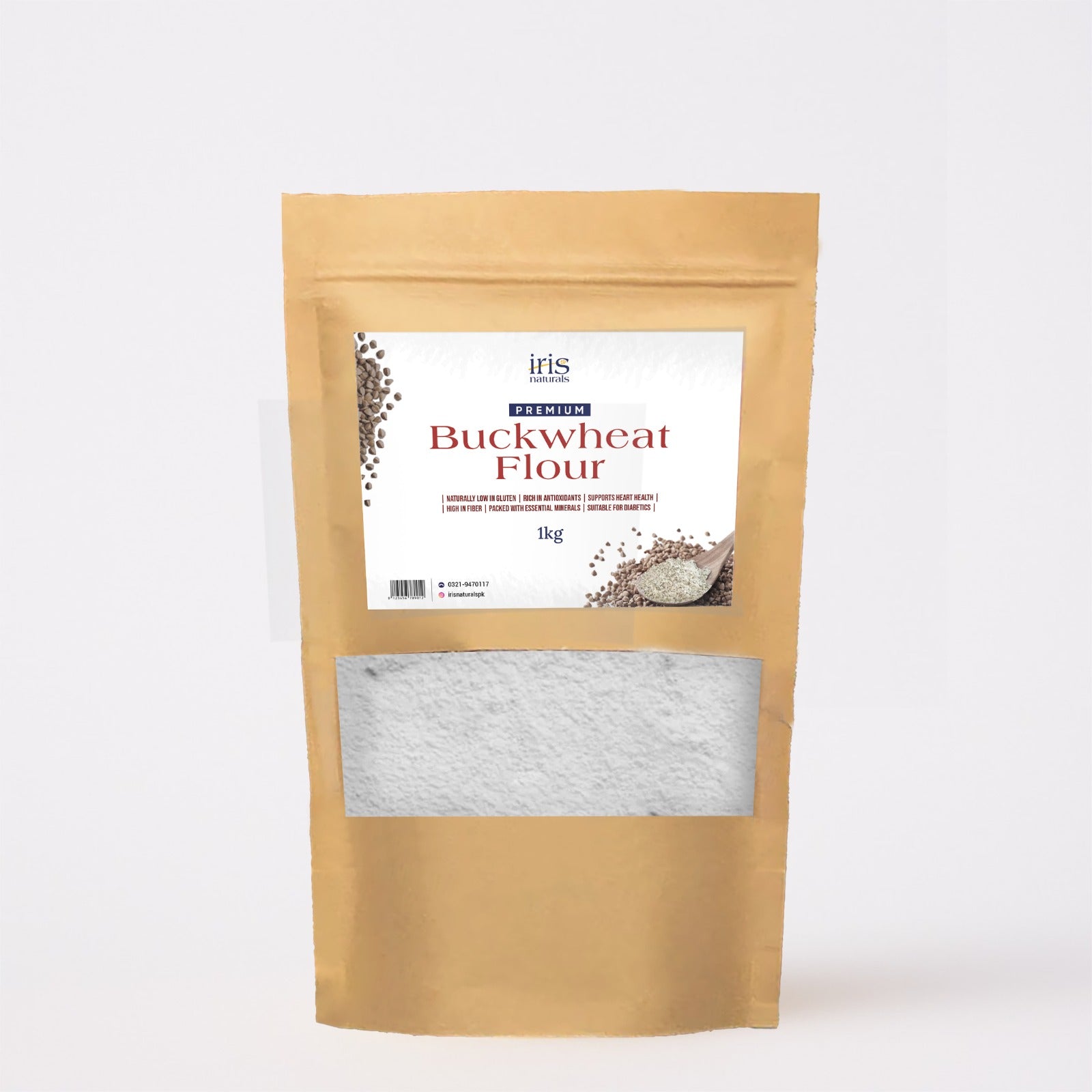
Buckwheat Flour by Iris Naturals / بکویٹ آٹا / Kuttu Atta / 1kg
Prevents Diabetes Lowers Cholesterol Balances Blood Highly Digestible Note: Organic products can naturally attract bugs. To keep them...
- Rs.1,699.00
- Rs.1,699.00
- Unit price
- per
10 customers are viewing this product


- Prevents Diabetes
- Lowers Cholesterol
- Balances Blood
- Highly Digestible
- Note: Organic products can naturally attract bugs. To keep them away, tightly seal the jar after use and keep it in a cold, dry place.
- Consult with a Doctor if you have any Skin issues
-
‘Buckwheat’- this name might suggest that it is a type of cereal similar to wheat. But buckwheat has no connection with grain whatsoever.
It is a fruit seed that is closely related to rhubarb, sorrel, and knotweed. These grain-like seeds have a unique triangular shape and are the same size as wheat kernels.
To make them edible, their outer hulls must be removed using specialized milling equipment. Its color varies from tannish pink to brown. Buckwheat Flour is also used in the treatment of diabetes.
Just like wheat, buckwheat can also be ground into flour and can be a suitable substitute for corn in the case of those who are gluten intolerant, as buckwheat is gluten-free.
The darker form of buckwheat is more nutritious. Buckwheat flowers attract bees that use them to produce a strongly flavored dark honey.
Buckwheat is available in roasted and unroasted forms. The roasted way is also known as ‘kasha’, which is widely used in traditional European dishes.
In the United States, it is commonly used in porridges and pancakes. The unroasted, whole buckwheat kernels are known as buckwheat grains or hulled buckwheat. Buckwheat Flour is also used in the treatment of diabetes.
Protection Against Breast Cancer
Research has proven that eating a diet rich in fiber from whole grains such as buckwheat reduces the risk of breast cancer.
Pre-Menopausal women who eat wholegrain fiber are at a lower risk of developing breast cancer. The antioxidant properties of buckwheat are used as an antidote for X-ray irradiation.
The antioxidants, lignin, play an essential role in estrogen reception and, hence, are beneficial for women during or after their menopause.
The plant lignin is converted into mammalian lignin in the intestines. One of these, called enterolactone, is believed to protect against breast cancer and other forms of cancer related to hormones. Buckwheat Flour is also used in the treatment of diabetes.
Related Products
Example product title
- Rs.1,699.00
- Rs.1,699.00
- Unit price
- per
Example product title
- Rs.1,699.00
- Rs.1,699.00
- Unit price
- per
Example product title
- Rs.1,699.00
- Rs.1,699.00
- Unit price
- per
Example product title
- Rs.1,699.00
- Rs.1,699.00
- Unit price
- per
Example product title
- Rs.1,699.00
- Rs.1,699.00
- Unit price
- per
Example product title
- Rs.1,699.00
- Rs.1,699.00
- Unit price
- per
- Choosing a selection results in a full page refresh.